Lanzko Insights
Practical notes on claims innovation and AI trends—built for claims leaders.
How do you pick the 100 files out of 1900 that need to be reviewed? Sampling is where audits quietly go wrong. It doesn’t have to be.

It’s Monday morning. You have a 1,900-line workers’ comp loss run from the TPA on your screen. The audit can’t start without a file list, two reviewers are waiting to begin, and the audit committee is expecting results in three weeks. Where do you start?
For most audit teams the answer looks the same. Sort by incurred. Grab the top 80. Sprinkle in 20 random picks. Copy the claim numbers into a new file. Call it a sample. Ninety minutes gone, and if anyone asks how you chose those files, the honest answer is a shrug.
The review itself gets all the attention. The selection that drives it gets almost none. That is backwards. A weak sample means a weak audit, no matter how good the review. And when a reinsurer, a regulator, or a plaintiff’s counsel asks how the files were chosen, “sort by incurred and take the top 80” is not an answer.
Why this matters at the executive level
For audit leaders, file selection is a craft problem. For claims executives, it is a risk exposure.
An indefensible sample only surfaces when something goes wrong. A reinsurer questions a book. A regulator opens a market conduct exam. A carrier is trying to figure why the TPA audit did not reveal systemic problems. In each case, the question is the same: how were these files chosen, and can the methodology be defended? The audit function was built to protect the operation. When the selection step is undocumented, biased, or unrepeatable, the audit is just an exercise in procedure instead of a valuable tool to mitigate risk.
Why file selection is hard
Manual selection drifts. It drifts toward the biggest open claims because those are easy to spot and comfortable to defend. Systemic issues in small or closed files never get looked at. One or two adjusters end up dominating the sample by accident. Others never appear at all. A purely random sample runs into a different problem, pulling too many files with limited information and skewing the audit toward not-applicable answers.
The sample is not reproducible. Run the same audit next quarter and you cannot recreate the logic you used the last time. The selection step is manual, biased, and undocumented. And it sits underneath every conclusion the audit makes.
Six ways to actually pick files
Before any tool matters, there is a framework worth carrying regardless. Each method answers a different audit question.
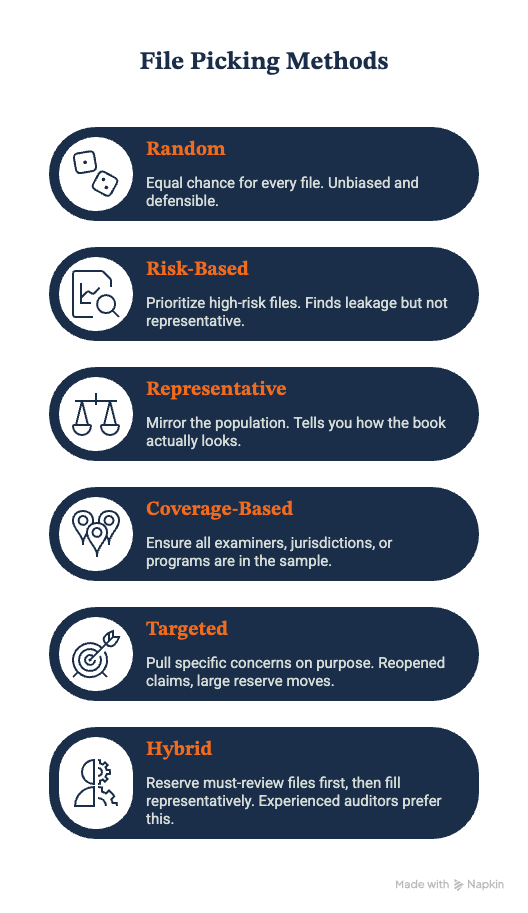
Selection criteria only produce good findings when they are applied to the right files. Selection is the multiplier. By hand, you can execute one method at a time. Combining them, on a messy file, in a way that another person can reproduce next quarter, is where the process falls apart.
Selection You Can Reproduce, Explain, and Defend
The problem is not a problem any more with AI and tools like The Audit Portal. This application is a claims audit system of record that uses AI to assist claim reviews from selection through review, findings, and reporting inside a single documented workflow. IntelliSelect is the file selection engine that starts every audit inside the Portal. It runs every method above and combines them.
Here is what actually happens.
You drop in the loss run straight from the TPA. Messy is fine. The AI reads the file, matches column names across TPA formats, and flags data problems before they cause trouble. Corrupted claim numbers. Duplicates. Missing exposure data. This is where AI does something a human cannot do reliably at speed.
You set the intent on one screen. Not formulas, not code. Plain controls covering the scope of the audit (target count, date range, lines of business), the composition you want (open and closed mix, exposure bands, litigation weighting), and the guardrails you need to hold (minimum files per examiner, must-include categories, SIU inclusion, risk flag prioritization).
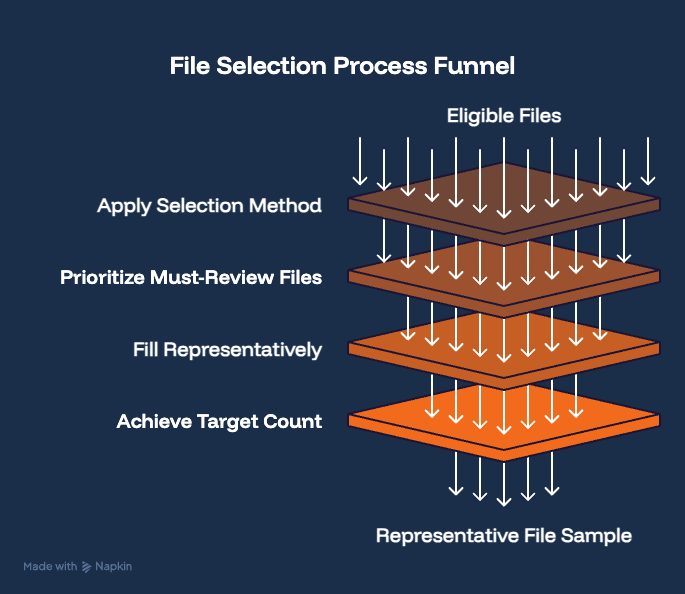
Then IntelliSelect builds the sample using a reserve-then-fill logic. Your non-negotiables lock in first (i.e. force-includes, examiner minimums, must-review flags). Those files are guaranteed before anything else happens. The remaining seats are filled to match the composition you asked for, backfilling as needed to hit the target count. Nothing is left to a random draw hoping the mix comes out right.
Before you commit, IntelliSelect shows the sample against your intent. A composition summary. A coverage check that flags any examiner left short. A one-line reason on every file explaining why it was picked. A seed value that will recreate the exact sample if anyone asks. You approve, and the audit file set is created inside the Audit Portal ready for review.
What this establishes that didn’t exist before
The tool matters. The infrastructure it creates matters more.
A system of record for how files are chosen. Every sample IntelliSelect produces carries the methodology used to build it. The intent, the levers, the reserved files, the fill logic, the seed. If a reinsurer asks how the sample was constructed, the answer is a document, not a memory. If a regulator asks three years later, the record is still there.
Consistency across audit cycles. The same intent produces the same kind of sample every quarter. If the audit committee sets a standard for how books get reviewed, IntelliSelect enforces it. Auditor turnover, workload spikes, and end-of-quarter shortcuts stop being risks to methodology because the methodology is in the tool, not in the auditor.
Consistency across audit teams. Multi-office audit functions run into the same problem large TPAs run into on the claims side. The same policy interpreted three different ways by three different people. IntelliSelect removes selection from that list. Two auditors running the same intent against the same loss run get the same sample.
Reproducibility as a feature, not a hope. A seed recreates a sample exactly. A second reviewer can be given the same files a peer reviewed and grade them independently. A quarterly re-audit can be run against the same selection to measure change over time. None of this is practical when the sample lives in an ad hoc spreadsheet.
Defensible methodology as a standing capability. The audit function no longer has to construct its defense after the fact. The defense is generated at the moment the sample is built.
This is what the Audit Portal was designed to establish across audit as a whole. Not just faster reviews, but a documented, consistent, and defensible record of how audit decisions were made. IntelliSelect is where that record starts.